

Resist Off-Label Marketing. Here's Why...
- Ben Weitz
- Dec 2, 2025
- 2 min read

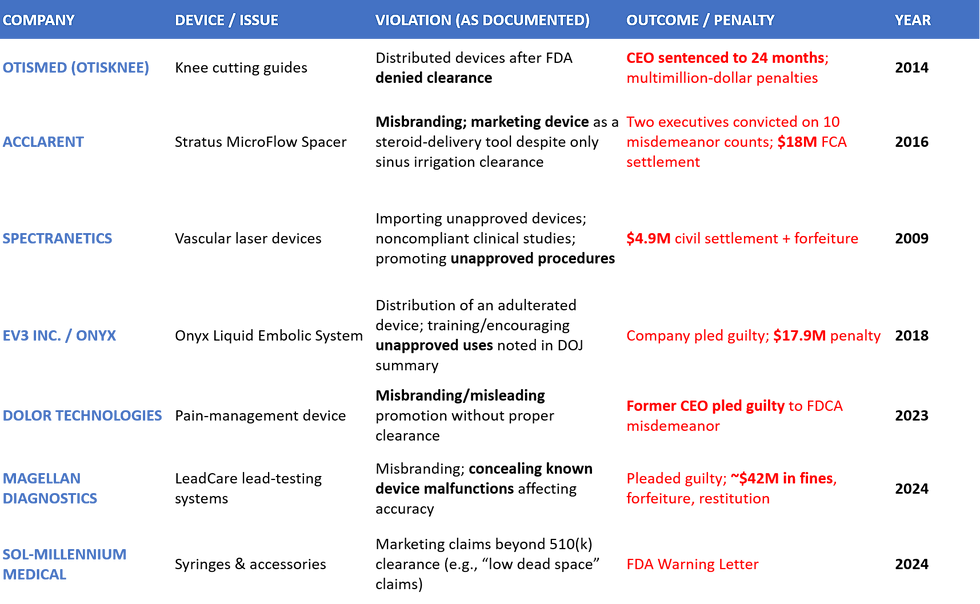
If you are experiencing any of the below, resist the temptation:
1. High commercial pressure + fewer resources
Smaller companies often operate with:
Limited sales forces
Investors demanding rapid revenue growth
Narrow product pipelines (one or two products)
This can create pressure to “stretch” marketing claims to drive adoption, especially if the approved indication is narrow.
But: Pressure does not reduce legal risk, it only increases temptation.
2. Misunderstanding of the regulations
FDA rules around “off-label marketing” vs. “scientific exchange” are complex. Small companies often lack:
In-house regulatory/compliance teams
Experienced legal counsel
Formal training programs
As a result, some employees incorrectly believe:
“If a doctor asks, we can tell them anything.”
“Off-label use is legal, so off-label promotion must be OK.”
Both are false.
3. Perception of lower visibility
Sometimes smaller firms believe they’re “under the radar” because:
They have low market share
Their product is not high-profile
They’re not on FDA’s “watch list” (at least in their mind)
But enforcement usually starts with whistleblowers, not regulators scanning advertisements. Even tiny companies get hit with investigations when:
A former sales rep files a qui tam lawsuit
A clinician complains to FDA
A competitor reports them
4. Misapplied startup culture
Some device startups adopt a tech-style “move fast” mentality. That works in software; in healthcare it’s dangerous.
Culture clash examples:
Sales teams encouraged to “tell the clinical story” beyond labeling
Executives assuming “the product works, so the rules are outdated”
Underestimating how heavily FDA and DOJ enforce marketing violations
5. Underestimating the consequences
Many smaller companies don’t appreciate how devastating the penalties can be:
FDA warning letters
DOJ civil or criminal charges
Corporate Integrity Agreements
Multi-million-dollar fines
Loss of reimbursement
Entire business collapse in some cases
For a small company, even a single enforcement action can be fatal.
6. “Everyone else is doing it” mentality
Sales reps hired from large device companies may carry habits or anecdotes about aggressive messaging in the past. Small firms sometimes interpret this as:
“This is just how the industry works.”
“We’ll get a slap on the wrist at most.”
But the regulatory environment in the 2020s is much stricter than in previous eras.
7. Lack of internal checks
Big companies have:
Compliance officers
MLR (Medical-Legal-Regulatory) review committees
Monitoring and auditing processes
Smaller companies might have none of these safeguards, so questionable messaging goes unchecked.
In short:
Small medical device companies don’t actually have less risk… often they have more. But pressure, inexperience, and misunderstanding of enforcement can create the illusion that they can get away with off-label marketing.


Comments